Himalayan Shilajit Resin, Drops & Powder Pouches: A Complete Buyer's Guide
Published 2026-10-23 · Updated 2026-10-23
A side-by-side comparison of Himalayan Shilajit resin jars, the liquid drops bottle, and resealable food-grade powder pouches — texture, packaging, lab testing, and how to choose a format for retail or bulk order.
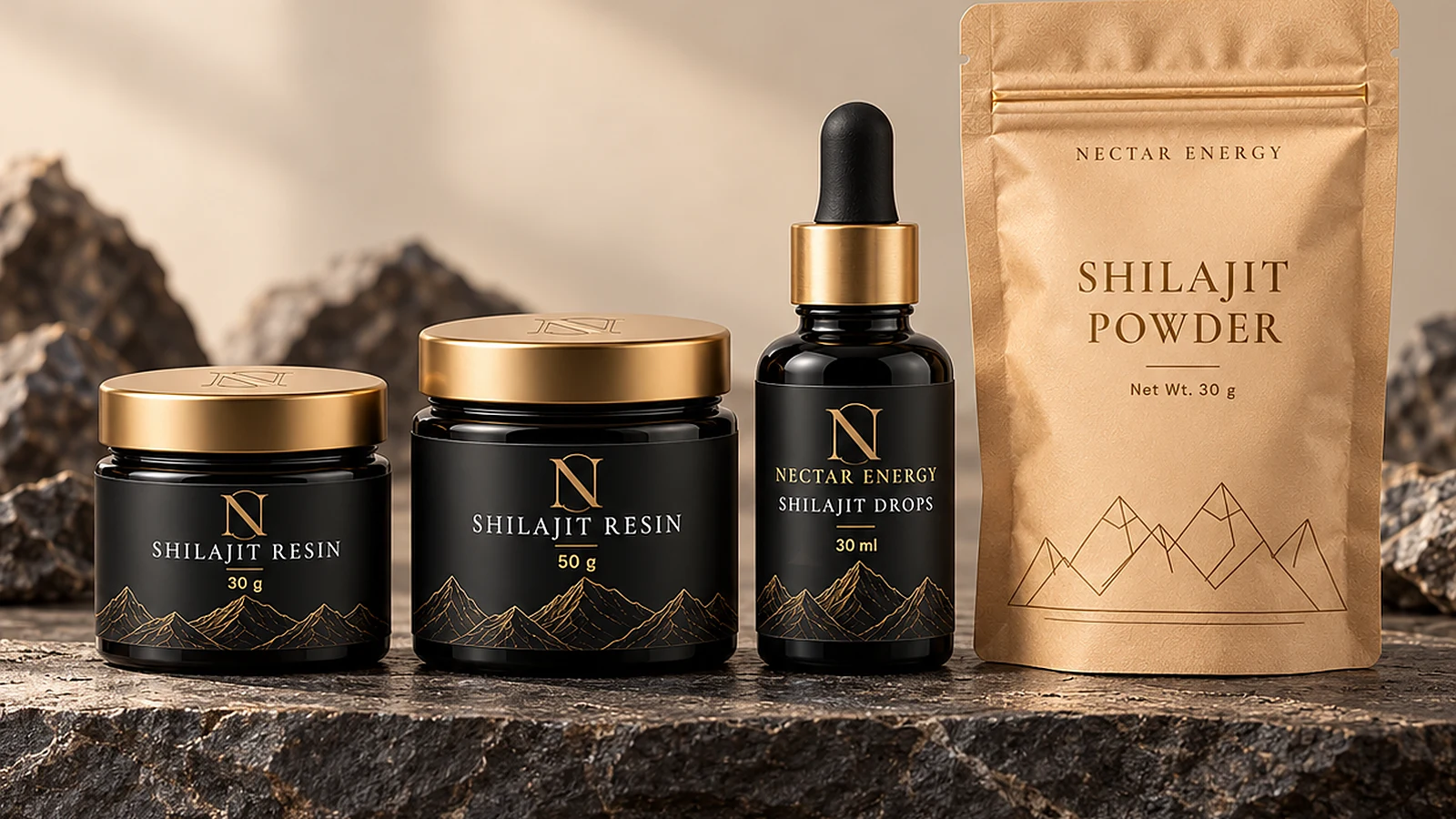
Himalayan Shilajit is sold in three distinct physical formats under one shilajit category: a dense mineral resin packed in sealed jars, a measured liquid in a dropper bottle, and a milled powder sealed in food-grade pouches. Each format offers a distinct texture, container type, and day-to-day handling routine. This guide compares all five live catalog SKUs — compact and larger resin jars, liquid drops, and compact and larger powder pouches — so a retail buyer in Pakistan or a bulk importer across the Middle East (UAE, Saudi Arabia, GCC), the US, the UK, Europe, and global markets can decide which pack format actually fits their shelf or their routine.
Five Shilajit Formats on One Catalog Page
Compact resin jar
The compact Shilajit resin jar is a dense, dark, semi-solid mineral mass that softens slightly at room temperature. It ships in a sealed jar designed to protect the resin from air and humidity during storage and transit.
Larger resin jar
The larger Shilajit resin jar holds a more generous supply of the same purified Himalayan resin, making it the preferred choice for regular daily users or households who want fewer reorders over time.
Liquid dropper bottle
The Shilajit liquid drops bottle is a liquid format packaged with an integrated dropper cap for measured dispensing, offering a clean, no-spoon routine for travel or office use.
Compact powder pouch
The compact Shilajit powder pouch is packed exclusively in a sealed, resealable food-grade pouch — never a rigid tub — protecting the dry milled powder from light and ambient moisture.
Larger powder pouch
The larger Shilajit powder pouch uses the same resealable food-grade pouch construction in a larger fill tier for regular kitchen or daily-routine use.
Resin vs Drops vs Powder: Texture, Packaging and Daily-Routine Use
The three formats are not interchangeable in texture or preparation. Resin arrives as a pliable, dense mass that a buyer portions in a small pea-sized amount and dissolves into warm water, milk, or tea. Drops are a ready-measured liquid dispensed by the dropper cap directly into a drink, which suits anyone who wants to skip portioning from a jar. Powder is a fine, free-flowing material from the food-grade pouch that stirs easily into warm water or tea, or gets mixed into a breakfast drink, and some buyers prefer stirring it into smoothies or food rather than dissolving a resin portion.
Packaging differs for a practical reason, not a cosmetic one. Resin needs an airtight jar because it is a dense, slightly tacky mass that would dry out or pick up moisture in a loose container. The dropper bottle exists purely to dispense the liquid format in consistent drops. Powder, being a dry, free-flowing material, is sealed in a food-grade pouch that can be flattened for shipping and resealed after opening — this is also why the powder SKUs are always supplied in resealable food-grade pouches.
Comparing Compact vs Larger Retail Pack Tiers
Both the resin line and the powder line are offered in two retail pack tiers: a compact starter option and a larger regular-use option. In jar-and-pouch packaging, container, labeling, and sealing steps are fixed per unit, so stepping up to the larger jar or larger pouch reduces packaging turnover for buyers who have already settled on their preferred format. First-time buyers often begin with the compact resin jar, the liquid dropper bottle, or the compact powder pouch to evaluate texture and routine fit, then step up to the larger jar or larger pouch on repeat orders.
Format and Packaging Summary Across the Range
| SKU | Physical Format | Primary Container |
|---|---|---|
| Himalayan Shilajit Resin (Compact) | Semi-solid mineral resin | Sealed jar |
| Himalayan Shilajit Resin (Larger) | Semi-solid mineral resin | Sealed jar |
| Himalayan Shilajit Drops | Measured liquid extract | Dropper bottle |
| Himalayan Shilajit Powder (Compact) | Free-flowing milled powder | Resealable food-grade pouch |
| Himalayan Shilajit Powder (Larger) | Free-flowing milled powder | Resealable food-grade pouch |
For retail orders within Pakistan, Cash on Delivery is available across all five SKUs. Buyers who want to try more than one format — such as pairing a resin jar with a liquid dropper bottle for travel — can combine multiple SKUs in a single domestic checkout.
Government Lab Testing: What the PCSIR Lahore Report Covers
A shilajit sample was tested at PCSIR Lahore, with a report dated 18 September 2026. The report recorded arsenic, mercury, cadmium, and lead as not detected in the sample tested. This finding applies to the specific sample submitted on that date, and the full report image is available for review on the quality page. Buyers evaluating resin, drops, or powder should request the report directly and confirm the sample description against the batch being proposed for their order rather than treating the result as a blanket claim across every future production run.
Choosing a Format for Your Routine or Your Shelf
Retail buyers generally choose based on handling preference rather than any difference in origin — all three formats come from the same Himalayan Shilajit source. Someone who travels frequently or wants a no-mess routine tends to prefer the drops bottle, since the dropper cap measures a serving without needing a spoon or a pinch from a jar. Someone comfortable dissolving a small portion into a warm drink each morning tends to prefer resin, particularly in the larger jar for ongoing daily use. Someone who wants to stir a measured scoop into a shake, a breakfast drink, or a cup of tea alongside other ingredients often finds the powder pouch easiest to portion and reseal. None of these are differences in the underlying material — they are packaging and texture differences that suit different daily routines.
Bulk and Wholesale Ordering Across All Five SKUs
B2B buyers can request a paid sample of any SKU above — resin, drops, or powder — with shipping quoted separately. Minimum order quantity is negotiable and confirmed only through a written quote submitted via For Businesses; no fixed MOQ is published against any format. Buyers can choose Nectar Energy branded packaging or a private-label arrangement where the same resin, drops, or powder is packed under their own brand, with jar, bottle, or pouch artwork kept within the verified format and lab-testing facts described above. Export orders ship to the buyer's destination airport — DXB or AUH for the UAE, RUH or JED for Saudi Arabia, and other GCC and international airports on request.
How to Order
Retail buyers in Pakistan can order any of the five SKUs directly from the product pages above, with Cash on Delivery available at checkout. B2B buyers should submit their product list, container formats, target quantities, and destination through Contact or by emailing customer@thenectarenergy.com, or start with For Businesses to review the sampling and quote process first. For background on sourcing and export procedure, see the earlier guide on wholesale Himalayan Shilajit supply from Pakistan.
Questions
How do I choose between the compact and larger Shilajit resin jars?
Both jars contain the same Himalayan Shilajit resin. First-time buyers often start with the compact jar to evaluate texture and daily routine fit, while regular daily users and households typically choose the larger jar for a longer-lasting supply.
How is Shilajit powder packaged for retail and wholesale orders?
Shilajit powder is packed exclusively in a sealed, resealable food-grade pouch across both the compact and larger pouch options, never in rigid jars.
Is Cash on Delivery available for retail Shilajit orders in Pakistan?
Yes. Cash on Delivery is available across Pakistan on all five Shilajit SKUs — both resin jars, the liquid dropper bottle, and both food-grade powder pouches.
What does the PCSIR Lahore lab report confirm about Shilajit?
Dated 18 September 2026, the report found arsenic, mercury, cadmium, and lead not detected in the shilajit sample tested. The full report is available on the Quality page; request it directly and match the sample details to your intended order.
Can I order a bulk mix of resin, drops, and powder in one wholesale quote?
Yes. List every SKU, container format, and target quantity in a single enquiry through the For Businesses or Contact page, and the written quote will cover all formats together, including private-label and destination-airport delivery options.