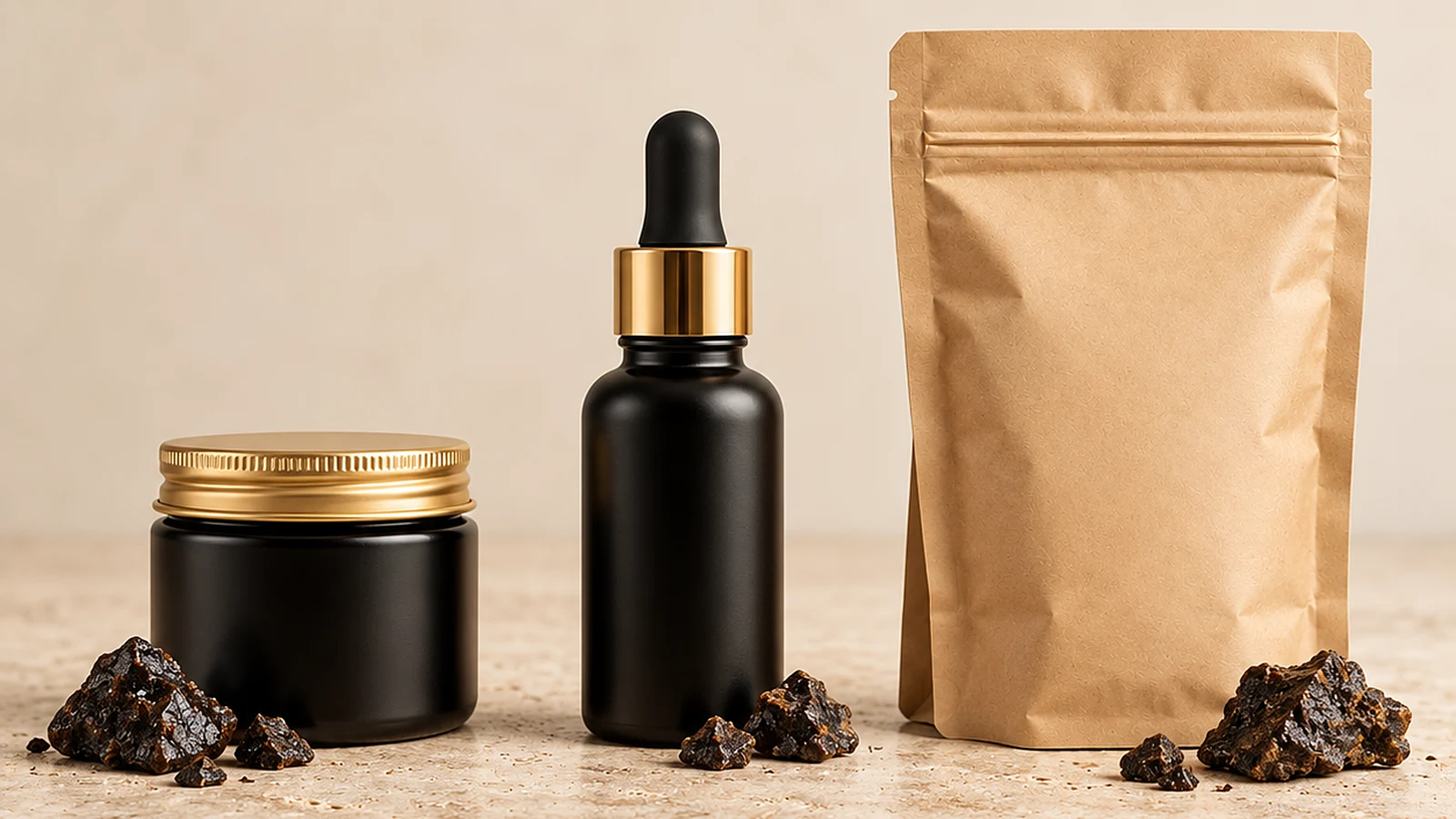
Dropper Bottle vs Resin Jar vs Food-Grade Powder Pouch: Choosing Your Shilajit Format
Published 2026-10-23 · Updated 2026-10-24
Compare The Nectar Energy's three Himalayan shilajit packaging formats: glass resin jars, liquid dropper bottles, and resealable food-grade powder pouches for wholesale and retail.
Cover illustration: packaging and documentation concepts, not an actual laboratory report, facility or customer order. Final artwork is subject to review.
A shilajit format decision is a specification decision: what physical presentation will the buyer stock, how will the pack be handled, and what information will the customer receive? The Nectar Energy offers resin in glass jars, liquid drops in dropper bottles, and powder in resealable food-grade pouches. These presentations deserve separate sample reviews rather than assumptions based on a shared category name. This guide helps wholesale and retail buyers sourcing from Pakistan compare closure design, handling, artwork, evidence, and warehouse planning. It supports a documented choice for each channel without making unsupported claims that one presentation outperforms another.
Define the Channel Before Comparing Formats
Start with how the product will be presented and handled in the intended channel. A specialist retailer may want to explain a resin jar in person, while an online listing needs clear images of the container and opening arrangement. A distributor managing several outlets may need consistent carton identification and receiving instructions across all presentations. Write these operational needs down before choosing a pack based on its appearance.
Describe the expected customer interaction without inventing product benefits. Will staff show an unopened sample, explain resealing, or answer questions about storage? Does the fulfilment team need a protective insert around glass? Will the display require the product name to remain visible at a particular viewing angle? These questions lead to practical sample checks that a buyer can observe.
Give resin, drops, and powder the same review process. Each should have its own product specification, packaging reference, and evidence questions. A mixed-format range can be appropriate when the buyer has a clear role for every presentation. A single-format start can be appropriate when the channel requirements are narrower. Record the reason for the selection so later additions can be evaluated against actual needs.
Assess Access and Closure on the Resin Jar
The resin presentation uses a sealed glass jar. Review the jar opening, lid, liner, and tamper feature as a complete assembly. A buyer should understand how the pack is opened and closed without relying on a photograph of the front label. Ask for a filled reference sample and the current component specification so the approved presentation is unambiguous.
Consider how staff will handle display and demonstration samples. Saleable jars should retain their original closure condition until the intended opening. If a reference jar is opened, identify it separately and follow the product instructions. Do not use repeated opening of normal inventory as a substitute for a planned sampling or receiving process.
For distribution, review the protective carton arrangement alongside the jar. Glass-to-glass contact, movement inside the carton, and pressure on the lid are practical concerns. Ask what evidence supports the proposed arrangement and what observations should trigger a receiving hold. Keep the approved jar and carton references linked; a container that is suitable on its own still needs appropriate protection through the planned route and warehouse handling steps.
Evaluate the Complete Dropper Bottle Assembly
Liquid drops use a dropper bottle rather than a resin jar or powder pouch. Review the bottle, closure, insert, and dispensing component together. Similar-looking components are not necessarily interchangeable, so ask for the exact references supplied with the approved sample. The buyer should confirm the product instructions rather than infer dispensing directions from the bottle design.
Inspect how the cap opens, how the assembly closes again, and whether the exterior remains clean during the intended handling demonstration. Any trial should follow the supplied instructions and use an authorised reference sample. A bottle photograph alone cannot establish closure performance, compatibility, or the expected user interaction. Record the observations that matter to the proposed retail channel.
Artwork and receiving checks should reflect the bottle shape. Keep product identification readable on the usable label surface, leave coding accessible, and avoid crowding the closure area. During transit review, inspect the neck and cap as well as the glass. If a later order proposes a different insert or closure, assess the change explicitly rather than assuming the original bottle approval covers every possible component combination.
Review the Powder Pouch as Its Own Format
Shilajit powder is supplied in a resealable food-grade pouch. It should be evaluated as a powder presentation with its own material and handling requirements. Ask for the pouch construction, food-contact documentation, original seal arrangement, and resealing instructions. A zipper supports opening and closing after use, while the original heat seal provides a separate unopened-pack checkpoint.
Inspect the filled pouch rather than an empty print sample alone. Check the top seal, corners, base, and the way the pouch stands or lies in the intended display. Powder must not obscure the zipper track during the handling demonstration. Keep the pack protected from moisture and sharp surfaces throughout sample storage and transport.
Do not transfer powder into a jar to make the display resemble the resin line. A consistent brand style can work across different physical containers without changing the assigned format. Review the actual pouch label area, including folds and seal zones, before approving a design. For fulfilment, ask how the pouch is protected from puncture and compression within the proposed mixed carton arrangement.
- Confirm the original heat seal and zipper as separate pack features.
- Review filled-pouch shape and readable artwork on the actual surface.
- Protect the pouch from moisture, abrasion, and sharp packing edges.
Compare Evidence Without Assuming Equivalence
A shared shilajit category does not establish that the three presentations are interchangeable in composition, handling, or report coverage. Request the relevant specification and available evidence for each proposed product. Where the supplier describes a relationship between materials or batches, ask for that explanation in writing and keep it with the order file.
The PCSIR Laboratories Pakistan report dated 18-09-2026 records heavy metals as not detected in the Shilajit sample examined. That is a sample-scoped finding. It should not automatically be applied to every resin jar, dropper bottle, or powder pouch offered now or later. Buyers should review the original report and ask how the proposed shipment relates to the sample.
Do not rank formats by unsupported performance language. Compare observable features such as container type, opening method, storage instructions, and documented evidence. If the buyer needs another attribute confirmed, identify the question and request suitable supporting information. A clear comparison table can separate established details from pending points, helping the purchasing team decide what it can approve and what still requires review.
| Decision point | Resin | Liquid drops | Powder |
|---|---|---|---|
| Assigned container | Sealed glass jar | Dropper bottle | Resealable food-grade pouch |
| Closure review | Lid and liner | Cap, insert, and bottle neck | Original seal and zipper |
| Handling review | Jar access and protected transit | Bottle instructions and closure fit | Dry handling and resealing |
| Evidence review | Relevant sample or batch connection | Relevant sample or batch connection | Relevant sample or batch connection |
Build a Sample Decision and Handover Record
Request samples against a defined checklist so the three formats receive comparable attention. Identify the product and batch, container references, artwork state, and questions the sample is intended to answer. Note whether it demonstrates a final production pack or only part of the design. This prevents a preliminary visual mockup from becoming an accidental approval of materials or closures.
During review, record the opening experience, label readability, closure condition, protective packing, and storage instructions. Keep evidence questions separate from physical observations. A neat pack does not establish report relevance, and a report does not demonstrate transit performance. Assign each open item to the person responsible for obtaining an answer before the order is released.
For a mixed-format launch, prepare receiving instructions for each pack and a common catalogue overview for the sales team. Use distinct product identities in the order and warehouse system so a jar cannot be substituted for a pouch without a documented decision. Retain the accepted reference photographs and specification revision for repeat orders. This creates a practical basis for expanding the range while keeping every presentation understandable to the buyer and receiving team.
Plan the Complete Catalogue and Buyer Handover
A packaging brief should cover the whole catalogue with equal attention to each line. Explore the shilajit collection, honey collection, herbal powders collection, and oral care collection before assembling a mixed order. The same written review process applies for buyers in the UAE, Saudi Arabia, Qatar, Kuwait, Oman, Bahrain, UK, USA, EU, and Pakistan. Destination details belong in the project specification so the buyer can confirm local requirements without changing the agreed product identity.
Use For Businesses to outline the intended distribution channel, artwork ownership, packing arrangement, and receiving schedule. Consult the quality documentation for the available report evidence, then contact the team with unresolved specification questions. Ask for a written response that identifies the proposed batch, packaging revision, and any information still awaiting approval. Keep that response alongside the purchase specification and receiving checklist so warehouse and commercial teams work from the same record.
| Product line | Required presentation | Handover focus |
|---|---|---|
| Himalayan Shilajit Resin | Sealed glass jar | Lid and liner fit |
| Shilajit Liquid Drops | Dropper bottle | Closure and insert fit |
| Shilajit Powder Pouch | Resealable food-grade pouch | Heat seal and zipper |
| Sidr Honey | Sealed glass jar | Liner and clean rim |
| Acacia Honey | Sealed glass jar | Closure integrity |
| Moringa Leaf Powder Pouch | Resealable food-grade pouch | Dry seal area |
| Ashwagandha Root Powder Pouch | Resealable food-grade pouch | Barrier and reseal |
| Peelu Miswak | Vacuum-sealed sleeve | Vacuum and seam integrity |
Questions
Which shilajit format is best for a distributor?
Choose against the intended channel, handling process, storage instructions, and available product evidence. Resin jars, dropper bottles, and powder pouches need separate sample reviews. Record observable requirements and unresolved questions rather than assuming one container is suitable for every retail or wholesale arrangement.
Does one laboratory result automatically cover all three formats?
No. The PCSIR Laboratories Pakistan report dated 18-09-2026 concerns the Shilajit sample examined and records heavy metals as not detected in that sample. Ask how the proposed product and shipment connect to that evidence before making a statement about any packaged presentation.
Can the powder presentation be ordered as a jar?
The powder presentation in this catalogue uses a resealable food-grade pouch. Keep that format in sample requests, mockups, and order specifications. Use a common brand design across the range if desired, while retaining separate physical templates and approval checks for the powder pouch and resin jar.
What should be checked on a dropper bottle sample?
Review the bottle, cap, insert, and dispensing component as one assembly. Follow the supplied instructions during an authorised demonstration and record closure fit, exterior condition, label readability, and coding access. Confirm component references so a later substitution can be reviewed against the accepted sample.
How can buyers launch more than one format together?
Prepare a distinct specification and receiving checklist for each presentation, then combine them in one project overview. Identify the role of every format in the intended channel. Keep product names, batch records, artwork revisions, and open evidence questions separate so the mixed launch remains traceable.