Food-Grade Pouches vs Glass Jars: Export & Wholesale Packaging Guide
Published 2026-10-23 · Updated 2026-10-24
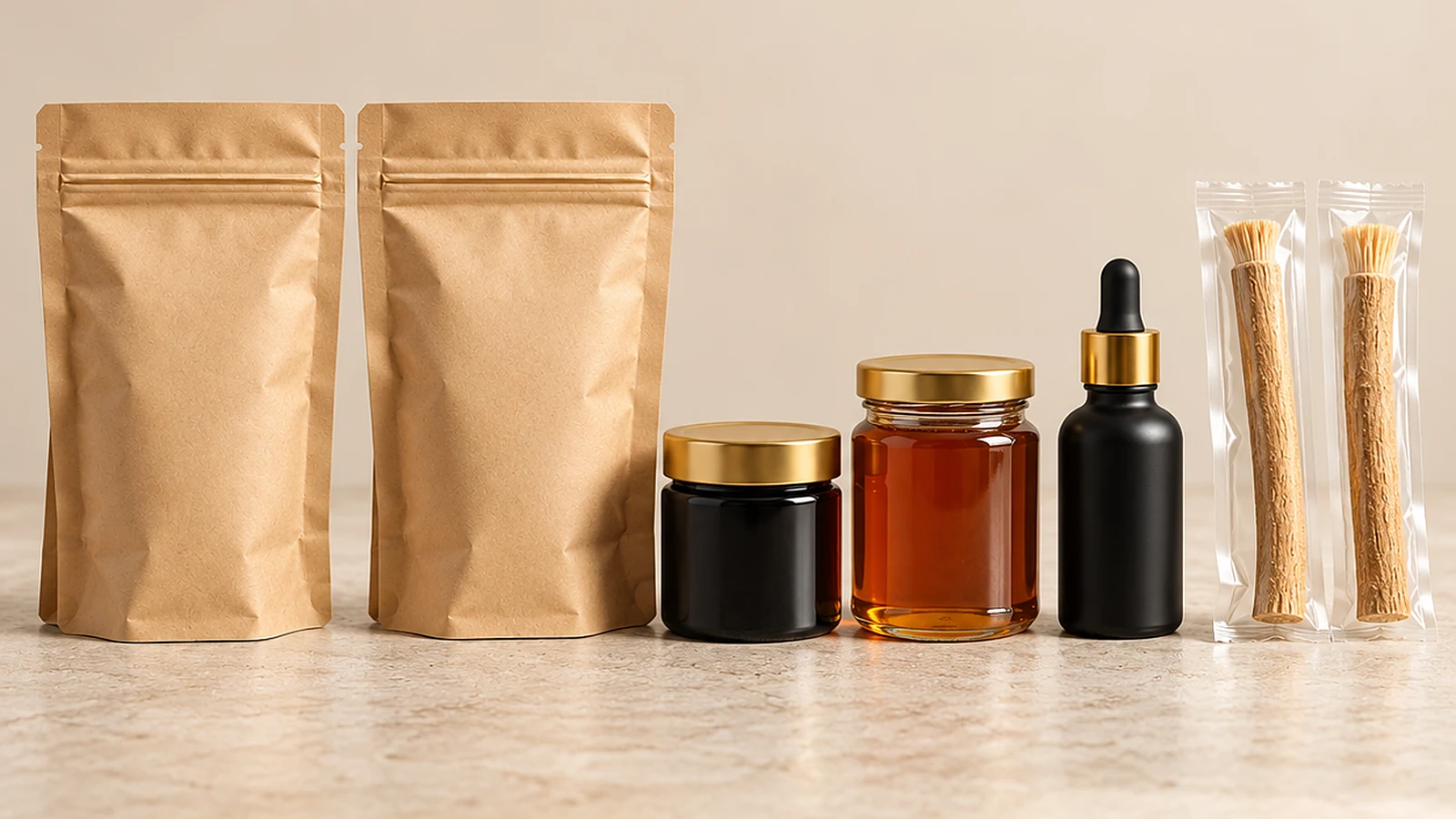
How The Nectar Energy packages herbal powders in food-grade pouches, shilajit resin and raw honey in jars, liquid drops in dropper bottles, and Peelu miswak in vacuum sleeves.
Cover illustration: packaging and documentation concepts, not an actual laboratory report, facility or customer order. Final artwork is subject to review.
Choosing export packaging begins with the physical product and the way people will handle it. A pouch and a glass jar are different containment systems, each with its own closure, barrier, inspection, and transit requirements. For The Nectar Energy catalogue from Pakistan, powders belong in resealable food-grade pouches, resin and honey belong in jars, liquid drops belong in dropper bottles, and Peelu miswak belongs in vacuum-sealed sleeves. This guide turns those format rules into a practical purchasing specification. It helps distributors compare samples, ask useful material questions, and document acceptance before approving a shipment or a private label design.
Match the Container to the Product
Begin with a format matrix rather than a visual preference. Powder needs a dry filling environment and a closure that permits controlled opening and resealing. Resin needs a jar opening that gives access to a dense material without relying on a narrow dispensing neck. Honey needs a compatible jar and closure arrangement that contains a flowing product. Liquid drops require a bottle assembly whose insert, cap, and neck work together. Miswak needs an intact vacuum sleeve around the individual stick.
These assignments should appear in the sample request, artwork brief, packing sheet, and order confirmation. If a mockup shows powder in a jar, correct the mockup before it becomes a production reference. An attractive visual should never override the product format specified for the line. In a mixed catalogue, a common label style can unify the range while the actual containers remain appropriate to each product.
Ask the supplier to identify the exact container and closure supplied with the reference sample. Record photographs of the unopened pack, its base, its opening, and its closure components. This creates a shared physical reference for later discussions about material substitutions, print placement, or dispatch discrepancies.
Specify Pouch Barriers and Reseal Details
Food-grade describes suitability for food contact; it does not tell a buyer everything about a pouch. Request a material specification identifying the contact layer, barrier construction, intended filling conditions, and supporting supplier documentation. A clear window, a matte finish, and a zipper are design features, but none independently establishes moisture protection. Assess the complete construction against the intended powder and the planned distribution conditions.
The heat seal and the zipper perform different jobs. The original heat seal protects the unopened pack, while the zipper supports resealing after opening. A zipper alone should not be mistaken for evidence that the original seal is intact. Check the tear area and opening sequence on a filled sample so a user can open the pouch without destroying the intended reseal function.
Powder trapped across a seal can undermine consistency. Ask how the filling process keeps the sealing area clear and how rejected seals are segregated. During sample review, inspect the pouch corners and base as well as the top edge. Request confirmation of the approved sealing setup rather than assuming one machine setting suits every material revision.
- Confirm the food-contact documentation for the actual pouch construction.
- Inspect the original heat seal separately from the resealable zipper.
- Approve filled samples showing the final print and opening arrangement.
Assess Glass Jars as Complete Closure Systems
A glass jar is only one part of the pack. The lid, liner, neck finish, and applied closure must form a compatible assembly. For honey, inspect the rim and closure area for product residue that could interfere with sealing or leave a sticky exterior. For resin, assess opening access and whether the approved liner remains suitable when the jar is opened and closed during normal handling.
Ask whether the closure reference on the specification matches the approved sample. A lid that looks similar can have a different liner or thread fit. Record the closure supplier reference and any agreed tamper feature so a later substitution requires review. Request filled-pack observations rather than relying only on photographs of empty components.
Glass needs protection against contact with neighbouring containers during transit. Dividers, cushioning, and carton layout should be designed together. Inspect whether jars can move inside the packed carton and whether closures carry unwanted pressure when cartons are stacked. A jar that arrives intact may still have a compromised closure, so receiving checks should examine leakage and closure condition as well as breakage. Keep any transit trial tied to its actual carton configuration.
Compare Handling and Transit Evidence
Avoid deciding that one format always travels better. A pouch may be punctured by sharp carton edges, while a jar can be damaged by impact or poor separation. Dropper assemblies introduce their own closure checks, and vacuum sleeves need protection from abrasion. Ask what handling conditions the proposed transit pack has been evaluated against and whether those conditions resemble the intended route.
A practical trial should use representative filled packs and the planned carton arrangement. Define observations before dispatch: exterior damage, leakage, seal changes, label lifting, and movement inside the carton. Photograph the packing arrangement before closing the trial carton so the receiving team can distinguish a packing issue from a handling event. Record observations consistently rather than simply marking the shipment acceptable.
The buyer and supplier should agree who evaluates a damaged sample and what evidence must be preserved. Keep the outer carton, internal dividers, affected pack, and tracking record together. Do not approve a different material merely because the original trial arrived without visible damage; changes to closure components, pouch construction, or carton layout can require a fresh review.
| Pack | Transit exposure to assess | Receiving observation |
|---|---|---|
| Powder pouch | Puncture and compression | Dry exterior and intact seams |
| Resin or honey jar | Impact and container contact | No fracture or leakage |
| Dropper bottle | Closure movement | Secure cap and clean neck |
| Miswak sleeve | Abrasion and seal damage | Vacuum remains intact |
Design Labels Around Real Packing Surfaces
Packaging artwork must fit the actual pack rather than a generic rectangle. On a stand-up pouch, folds, the base, the zipper, and the seal areas reduce the usable print surface. On a jar, curvature and the label overlap influence where text remains readable. On a dropper bottle, the label must leave the closure accessible. A sleeve design must leave the seam and seal area suitable for inspection.
Request a supplier-approved template for each container before placing text. Keep essential identification clear of folds, seams, and heavily curved surfaces. Provide a designated area for batch and date coding that remains readable after filling and packing. Confirm that any label adhesive is compatible with the actual surface and the expected handling environment.
A final proof should show the complete pack, including the back panel and closure. Compare the physical sample with the artwork revision, not just with an isolated digital label. If several products share one visual system, retain separate approved files for each format. This prevents an approved jar design from being reused on a pouch without checking its practical layout constraints.
Set Written Acceptance Before Production
Turn the sample decision into a concise acceptance sheet. Identify the product, container reference, closure components, artwork revision, coding position, and transit packing arrangement. Separate confirmed items from open questions. A purchasing team should be able to determine which sample was approved without reconstructing an email conversation or comparing unlabelled photographs.
Define how deviations will be handled. A different pouch film, lid liner, label material, or carton divider should be described before use and reviewed against the original purpose. Some changes may be acceptable after a sample check; others may require a new filled-pack evaluation. The important point is that the decision is documented and linked to the actual shipment.
At handover, give the receiving warehouse a short checklist that mirrors the approved pack. Include outer carton condition, product identity, batch coding, closure integrity, and any evidence required for a hold decision. Record who can release stock after an inspection concern. Packaging works best as a connected specification from sample approval to receipt, with every team using the same product and component references.
Plan the Complete Catalogue and Buyer Handover
A packaging brief should cover the whole catalogue with equal attention to each line. Explore the shilajit collection, honey collection, herbal powders collection, and oral care collection before assembling a mixed order. The same written review process applies for buyers in the UAE, Saudi Arabia, Qatar, Kuwait, Oman, Bahrain, UK, USA, EU, and Pakistan. Destination details belong in the project specification so the buyer can confirm local requirements without changing the agreed product identity.
Use For Businesses to outline the intended distribution channel, artwork ownership, packing arrangement, and receiving schedule. Consult the quality documentation for the available report evidence, then contact the team with unresolved specification questions. Ask for a written response that identifies the proposed batch, packaging revision, and any information still awaiting approval. Keep that response alongside the purchase specification and receiving checklist so warehouse and commercial teams work from the same record.
| Product line | Required presentation | Handover focus |
|---|---|---|
| Himalayan Shilajit Resin | Sealed glass jar | Lid and liner fit |
| Shilajit Liquid Drops | Dropper bottle | Closure and insert fit |
| Shilajit Powder Pouch | Resealable food-grade pouch | Heat seal and zipper |
| Sidr Honey | Sealed glass jar | Liner and clean rim |
| Acacia Honey | Sealed glass jar | Closure integrity |
| Moringa Leaf Powder Pouch | Resealable food-grade pouch | Dry seal area |
| Ashwagandha Root Powder Pouch | Resealable food-grade pouch | Barrier and reseal |
| Peelu Miswak | Vacuum-sealed sleeve | Vacuum and seam integrity |
Questions
Are herbal powders available in glass jars?
For this catalogue, shilajit powder, moringa leaf powder, and ashwagandha root powder use resealable food-grade pouches. The original heat seal and the zipper have separate functions. Buyers should request the actual pouch material specification and a filled sample before approving artwork or an export packing arrangement.
What should a buyer request for a food-grade pouch?
Request the contact-layer and barrier specification, supporting food-contact documentation, opening details, and an example of the final heat seal. Review the intended powder and handling environment with the supplier. A pouch finish or zipper alone does not establish the performance of the complete pack.
Does a glass jar remove the need for transit checks?
No. The jar, lid, liner, dividers, and carton form one packing arrangement. Inspect representative filled packs for leakage, movement, and damage after the planned handling trial. Preserve the packing layout reference so a later carton or closure change can be assessed against the approved version.
Can one label template cover every product?
Use a consistent brand style while keeping a separate template for each container. Pouch folds, jar curvature, bottle closures, and sleeve seams create different usable areas. Approve the complete physical presentation and leave readable space for batch identification and date coding on each product.
How should a mixed export enquiry be prepared?
List each product, its required format, the destination, and the intended receiving channel. Include artwork status and any packaging questions. Share the specification through the business or contact page, then retain the agreed sample references and written acceptance details with the shipment record.