How PCSIR Lahore & NIH Islamabad Lab Testing Works for Shilajit and Sidr Honey
Published 2026-10-23 · Updated 2026-10-24
Understand how PCSIR Laboratories Pakistan tests Himalayan shilajit for heavy metals and how NIH Islamabad evaluates Sidr honey batch FIT-SIDR-02 at The Nectar Energy.
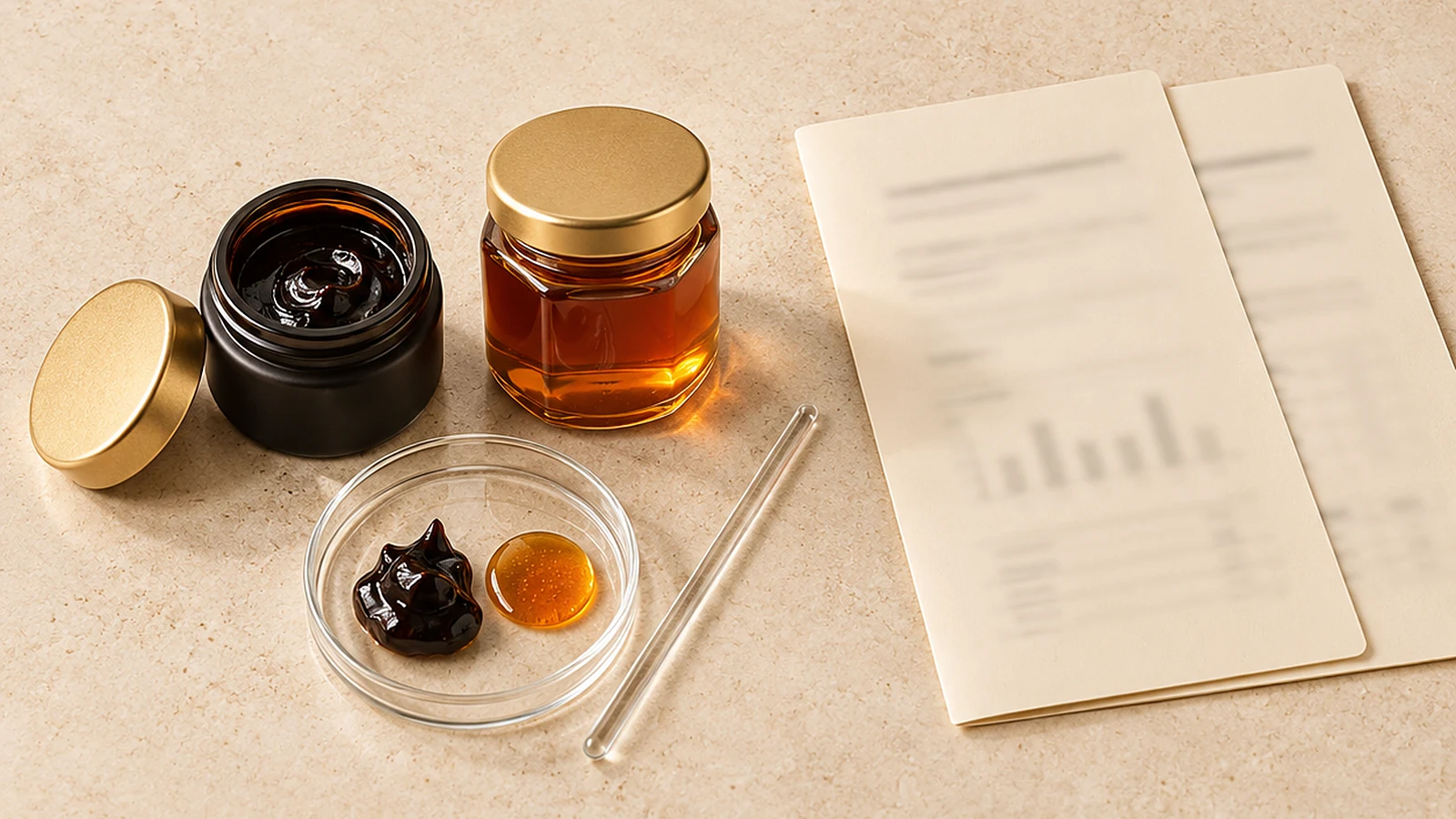
Cover illustration: packaging and documentation concepts, not an actual laboratory report, facility or customer order. Final artwork is subject to review.
A laboratory report is useful when a buyer can connect its findings to a clearly identified sample. It becomes less useful when a short headline hides the date, sample description, or limits of the examination. The Nectar Energy documentation discussed here concerns one Shilajit sample reported by PCSIR Laboratories Pakistan and one identified Sidr honey batch reported by NIH Islamabad. This guide explains how export and private label buyers in Pakistan can read those records, preserve their scope, and ask for evidence relevant to a proposed shipment. It does not extend either finding to every product or future batch.
Start with the Report Identity and Sample Trail
Begin with the complete report rather than a cropped result or a message summarising it. Read the laboratory name, report date, sample description, stated examinations, and conclusion together. If a reference or sample identifier appears, retain it in the buyer file. Ask for a readable copy that includes the relevant pages so qualifications and notes remain attached to the result.
The sample trail is the connection between the material submitted and the goods being offered. A report can describe a sample accurately while leaving that commercial connection unresolved. Ask the supplier how the proposed shipment relates to the submitted sample, what batch record supports that connection, and whether any processing or packaging changes occurred afterwards. Mark unanswered points as open items rather than inferring an answer from a matching product name.
This review is a purchasing control that buyers can apply consistently. It does not require turning a laboratory document into a general marketing badge. Keep the evidence file organised by product and batch, with the supplier response beside the report. That arrangement helps another reviewer understand both the finding and the remaining questions without relying on verbal explanations.
Read the PCSIR Shilajit Finding Precisely
The PCSIR Laboratories Pakistan report dated 18-09-2026 concerns a Shilajit sample and records heavy metals as not detected in that sample. Keep the laboratory, date, material, and sample scope together whenever describing this finding. Do not rewrite it as a standing guarantee for all Shilajit supplied under the brand, and do not transfer it automatically to every packaged format.
Not detected is a laboratory reporting outcome within the examination described in the report. It should not be expanded into a claim that every possible substance was examined or that absence has been established without limit. Buyers should consult the original document for the reported items, method information, reporting conventions, and any explanatory notes. If details needed for a purchasing decision are unclear, request clarification before making a statement of their own.
For a proposed order, distinguish the identity of the tested sample from the identity of the shipment. Ask what documentation supports their relationship and whether further examination is needed for the buyer's intended specification. Resin, liquid drops, and powder are different commercial presentations; shared category membership alone does not demonstrate that one sample result covers each presentation.
Read the NIH Sidr Honey Finding Precisely
The NIH Islamabad report dated 03-08-2026 identifies Sidr honey batch FIT-SIDR-02 as satisfactory and records a negative Fiehe test. These are the findings that can be repeated with their batch and date context. Satisfactory should remain connected to the examination and conclusion documented in that report rather than becoming a universal statement about every attribute of the honey.
The negative Fiehe result is one named result in that batch record. It is not a substitute for reading the complete report or for confirming the buyer's own product specification. Do not infer from that single result that every authenticity question, storage condition, or destination requirement has been resolved. A distributor should avoid shortening the finding to an unqualified statement that the whole honey range has identical evidence.
Acacia honey is a separate product line and should have its own evidence review. A Sidr batch reference cannot be relabelled as an Acacia report. The same rule applies to a later Sidr batch: first establish its own identification and available supporting records. This keeps catalogue presentation clear while allowing buyers to ask informed questions about the actual goods offered for dispatch.
| Document | Date and scope | Recorded finding |
|---|---|---|
| PCSIR Laboratories Pakistan | 18-09-2026; Shilajit sample | Heavy metals not detected in the sample tested |
| NIH Islamabad | 03-08-2026; Sidr honey batch FIT-SIDR-02 | Satisfactory; Fiehe test negative |
Build a Shipment Evidence Checklist
Once the report is understood, compare it with the proposed shipment specification. Record the ordered product name, proposed batch, packaging format, and supplier's explanation of the evidence link. Keep report dates visible beside the order reference. A report being available is different from its relevance being established for the shipment, so track those two questions separately.
Ask which documents will accompany dispatch and which are available for review before approval. The buyer should confirm destination-specific documentation with the responsible importer or qualified local adviser. This article does not establish that either report alone authorises entry, listing, or sale in any destination. Document needs can depend on the product, presentation, and route, so the written enquiry should identify those details.
Use one shared register for outstanding evidence requests. Assign an owner and a response date to each item, then retain the final response with the order file. If the supplier proposes a different batch before dispatch, revisit the report connection rather than carrying forward an earlier approval without checking. A simple change record prevents a well-reviewed sample file from becoming disconnected from the delivered goods.
- Identify the proposed shipment batch before accepting a report connection.
- Keep complete report copies and supplier explanations in the same file.
- Recheck unresolved evidence whenever the proposed product or batch changes.
Keep Lab Statements Consistent Across Artwork
A report statement can lose its meaning when it moves between a buyer presentation, a product label, and an online listing. Prepare one approved wording record containing the laboratory, date, sample or batch, and finding. Ask each team to work from that record instead of writing its own abbreviated version. Keep the original report accessible to whoever checks the final copy.
Do not place the Sidr batch statement on Acacia honey, powder pouches, miswak sleeves, or another unrelated product. Do not place a general laboratory seal on every pack merely because two reports exist within the catalogue. Any proposed use of a laboratory name or visual mark should be checked for appropriate permission and accurate context before printing.
Review translations with the same attention as the source text. A translated adjective that sounds broader than the documented finding can change the meaning of the claim. The buyer should verify the wording intended for each destination and record the approved revision. If the batch changes, check whether the printed statement remains accurate before releasing the artwork for another production run.
Agree What Happens When Evidence Is Incomplete
An unanswered question should lead to a defined purchasing decision. Buyers can hold approval, request a clearer document, seek a batch explanation, or ask what further testing would address a specific gap. The request should state the information needed and the product concerned. A vague demand for more assurance often produces another general statement instead of evidence that resolves the original question.
Separate report interpretation from packaging inspection. A readable laboratory record does not show that a jar arrived sealed, and a clean exterior does not establish a sample result. Both checks can sit in the same receiving plan, but they answer different questions. Give warehouse staff clear instructions for holding damaged or incorrectly identified packs while the documentation reviewer assesses the evidence file.
Keep the final decision traceable to named records. Note which report was reviewed, how the batch relationship was explained, and which specification items were accepted. Where a point remains unresolved, state it plainly in the handover. That discipline makes repeat enquiries easier because the next reviewer can identify what was actually established without reconstructing the entire discussion.
Plan the Complete Catalogue and Buyer Handover
A packaging brief should cover the whole catalogue with equal attention to each line. Explore the shilajit collection, honey collection, herbal powders collection, and oral care collection before assembling a mixed order. The same written review process applies for buyers in the UAE, Saudi Arabia, Qatar, Kuwait, Oman, Bahrain, UK, USA, EU, and Pakistan. Destination details belong in the project specification so the buyer can confirm local requirements without changing the agreed product identity.
Use For Businesses to outline the intended distribution channel, artwork ownership, packing arrangement, and receiving schedule. Consult the quality documentation for the available report evidence, then contact the team with unresolved specification questions. Ask for a written response that identifies the proposed batch, packaging revision, and any information still awaiting approval. Keep that response alongside the purchase specification and receiving checklist so warehouse and commercial teams work from the same record.
| Product line | Required presentation | Handover focus |
|---|---|---|
| Himalayan Shilajit Resin | Sealed glass jar | Lid and liner fit |
| Shilajit Liquid Drops | Dropper bottle | Closure and insert fit |
| Shilajit Powder Pouch | Resealable food-grade pouch | Heat seal and zipper |
| Sidr Honey | Sealed glass jar | Liner and clean rim |
| Acacia Honey | Sealed glass jar | Closure integrity |
| Moringa Leaf Powder Pouch | Resealable food-grade pouch | Dry seal area |
| Ashwagandha Root Powder Pouch | Resealable food-grade pouch | Barrier and reseal |
| Peelu Miswak | Vacuum-sealed sleeve | Vacuum and seam integrity |
Questions
What exactly does the PCSIR report support?
The PCSIR Laboratories Pakistan report dated 18-09-2026 records heavy metals as not detected in the Shilajit sample examined. That statement belongs to the specified sample and report. Buyers should read the original document and establish the connection to a proposed shipment before repeating the finding in their own materials.
Which Sidr honey batch is covered by the NIH finding?
The NIH Islamabad report dated 03-08-2026 concerns Sidr honey batch FIT-SIDR-02. It records a satisfactory conclusion and a negative Fiehe test. Keep those details together and request the full report when reviewing the batch, rather than using a general statement about the entire honey collection.
Does the Sidr honey report apply to Acacia honey?
No. Acacia honey is a different product and needs its own evidence review. A report for Sidr honey batch FIT-SIDR-02 should not be used as evidence for Acacia honey or for another Sidr batch without a documented basis relevant to the actual goods proposed.
Can a report replace packaging and receiving inspections?
No. The laboratory record describes its submitted sample and stated examinations. Receiving checks establish product identity, closure condition, coding, and transit damage at arrival. Keep both records in the order file, and give each reviewer clear responsibility for the questions their inspection can answer.
What should an importer ask before approving an order?
Ask for complete readable reports, the proposed batch identification, and a written explanation connecting the evidence to the goods. Confirm destination documentation separately with the responsible importer. Resolve any report gaps before approving a statement for labels, buyer presentations, or online listings.